Royal Conservatory of Music (RCM) Pass Assurance Program
For students who thrive on clear goals, measurable progress, and recognized achievement, Music Pillars offers preparation for Royal Conservatory of Music (RCM) examinations through Level 6. Through the pass-assurance program, we guarantee your child will pass the examination or we will pay for the second examination and training at no additional cost!
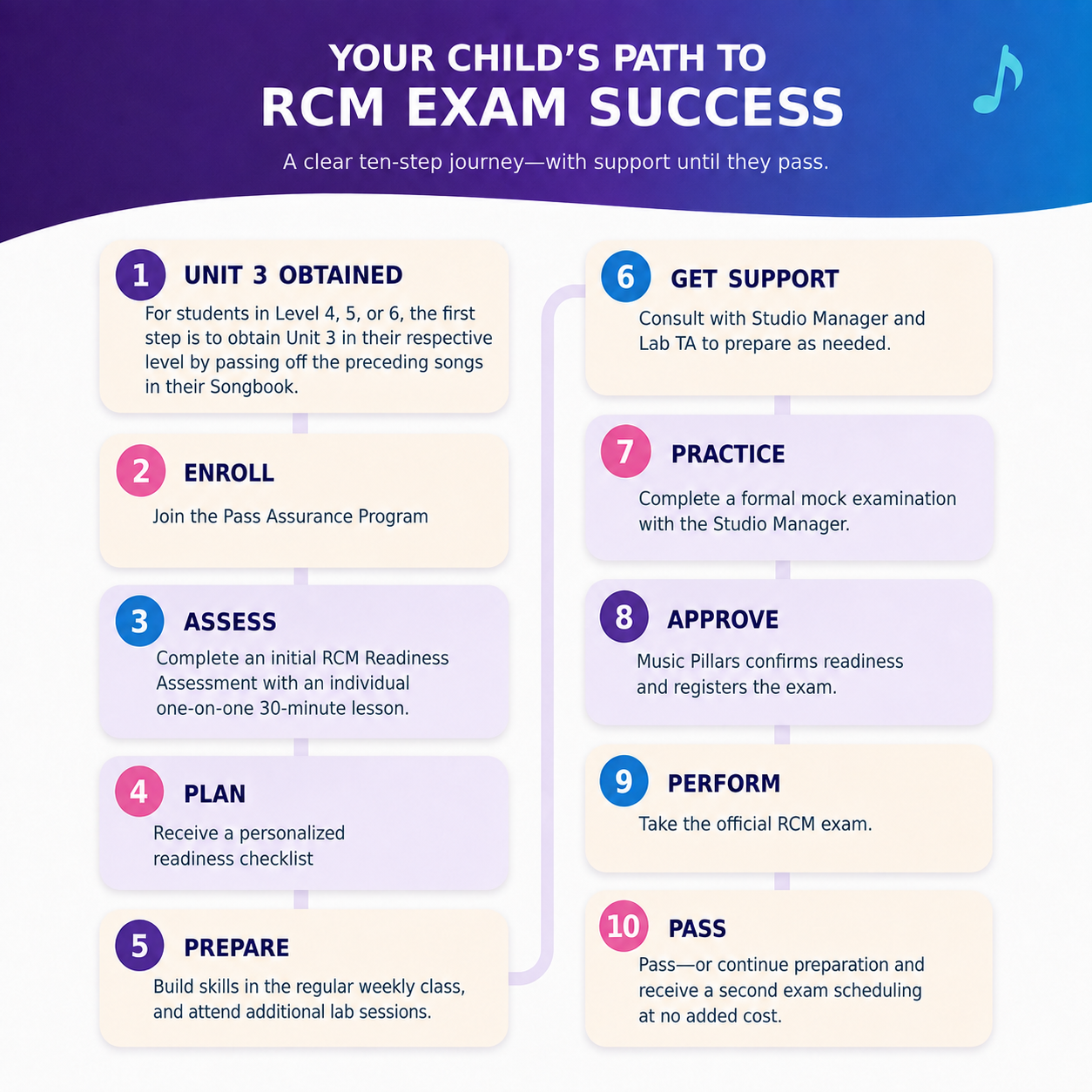
Unit 3 Obtained
For students in Music Pillars Levels 4, 5, or 6, the first step is reaching Unit 3 in their current Songbook. Students accomplish this by learning and passing off the songs in the preceding units. This milestone demonstrates that they have developed most of the foundational skills needed for their corresponding RCM examination level. Once Unit 3 is obtained, the student is ready to begin the formal RCM preparation process.Enroll
The parent enrolls the student in the RCM Pass Assurance Program by paying a one-time program fee. This fee includes the official RCM examination fee, additional preparation and lab support, readiness assessments, mock examinations, and registration assistance. It also includes continued preparation and a second examination fee if the student does not pass on the first attempt. Students must remain actively enrolled in their regular Music Pillars class and complete all assigned preparation to maintain the guarantee.Assess
Each student begins with an individual, one-on-one, 30-minute RCM Readiness Assessment. During this lesson, the instructor evaluates the student’s repertoire, technique, sight-reading, ear training, and other required examination skills. The purpose is to identify what the student already knows and what still needs attention. This gives the studio, teacher, parent, and student a clear and realistic starting point.Plan
Following the assessment, the student receives a personalized readiness checklist. This checklist breaks the examination requirements into clear, manageable goals and provides a shared progress-tracking system for the family and teaching team. It identifies the student’s selected repertoire as well as the technical and musicianship skills that must be completed. The plan is updated as the student progresses toward examination readiness.Prepare
Most of the student’s preparation continues during their regular weekly Music Pillars class. Students also receive additional lab practice time to strengthen repertoire, technique, ear training, sight-reading, and other examination requirements. Lab sessions allow students to work more intensively on specific areas without replacing their regular instruction. Consistent participation and practice help the student make steady progress toward the required standard.Get Support
The Studio Manager and Lab Teaching Assistant provide additional guidance throughout the preparation process. They review the student’s progress, help solve specific musical or technical problems, and recommend additional preparation when needed. This support keeps the student from becoming stuck or developing weaknesses close to the examination date. It also helps ensure that the regular teacher, support staff, student, and parent remain on the same page.Practice
Before taking the official examination, the student completes a formal mock examination with the Studio Manager. The mock examination recreates the structure and expectations of the actual RCM exam as closely as possible. It gives the student experience performing the complete program under pressure while revealing any remaining areas that need improvement. The results are used to determine the student’s final preparation priorities.Approve
Music Pillars approves the student for the examination only after confirming that the student is ready. Readiness includes repertoire, technical requirements, ear training, sight-reading, and any other requirements for the student’s examination level. Once the student has met the required standard, Music Pillars completes the official exam registration. This approval process prevents students from being registered prematurely and gives them the strongest reasonable opportunity to succeed.Perform
The student takes the official Royal Conservatory of Music piano examination. By this point, the student has completed the readiness checklist, participated in the required preparation, and successfully completed a mock examination. The goal is for the student to enter the exam feeling familiar with the process and confident in the material. The examination provides an independent evaluation of the student’s musical achievement.Pass
When the student passes, they receive official recognition from the Royal Conservatory of Music for completing that examination level. If the student does not pass on the first attempt, Music Pillars continues providing preparation and schedules a second examination at no additional cost. The student must remain enrolled in their regular Music Pillars class and complete all assigned preparation for the Pass Assurance guarantee to remain valid. The commitment is straightforward: we continue supporting the student until they pass.
The RCM Certificate Program is one of the most respected music assessment systems in North America. Students work toward nationally standardized performance benchmarks and receive evaluations from independent examiners who assess their skills according to established criteria.
Why Families Choose the RCM Program
Clear Achievement Milestones
Students progress through a structured sequence of levels, each with specific technical, musical, and performance requirements.
Independent Evaluation
Exams are conducted by trained Royal Conservatory examiners, providing objective feedback from outside adjudicators rather than only the student's teacher.
Motivation Through Goal Setting
Having a defined examination date and performance standard helps many students stay focused and engaged.
Nationally Recognized Credentials
Successful completion of levels earns official certificates and provides documented evidence of musical achievement.
What are the musical skills included in a RCM Exam?
Repertoire (Performance Pieces)
Students prepare a selection of pieces from different musical styles and historical periods.
The examiner evaluates:
Musical expression
Tone quality
Rhythm and accuracy
Articulation
Dynamics
Stylistic understanding
Overall performance quality
This section helps students develop confidence, artistry, and polished performance skills.
Technical Requirements
Students demonstrate fundamental piano skills that build fluency and facility at the keyboard.
Technical work includes:
Scales
Chords
Arpeggios
Cadences (at certain levels)
The examiner evaluates:
Accuracy
Consistency
Evenness
Fingering
Tempo control
Technical security
Strong technical skills create the foundation for successful performance of more advanced repertoire.
Ear Training (Aural Skills)
Students complete listening exercises designed to strengthen musicianship.
Skills may include:
Identifying intervals
Recognizing chords
Detecting rhythmic patterns
Singing short musical examples
Demonstrating musical awareness by ear
These activities help students develop the listening skills necessary for confident musicianship.
Sight Reading
Students are asked to perform music they have never seen before.
The examiner evaluates:
Note-reading accuracy
Rhythm reading
Musical continuity
Pulse and tempo maintenance
Strong sight-reading skills help students learn music more efficiently and become more independent musicians.
How Students Are Evaluated
Each examination is scored according to nationally standardized criteria.
Students receive:
A numerical score
Written examiner comments
Detailed feedback on strengths and areas for growth
Official recognition upon successful completion
Typical achievement levels include:
Pass
First Class Honors
First Class Honors with Distinction
These benchmarks provide families with a clear understanding of a student's musical progress.
Who Is the RCM Program Best For?
The Royal Conservatory pathway is an excellent fit for students who:
Enjoy working toward specific goals
Thrive with measurable achievement
Like receiving formal feedback
Are motivated by certificates and accomplishments
Want a comprehensive music education that develops performance, technique, musicianship, and reading skills
At Music Pillars, students can participate in the RCM program while still enjoying engaging lessons, performances, recitals, and a supportive learning environment that makes musical growth both rewarding and enjoyable.