About
How Do I Know If My Child Is Actually Making Progress in Music?
It is fair to say that some learning in music is subjective and may not always be quantifiable. But most learning in music can be observed and measured.
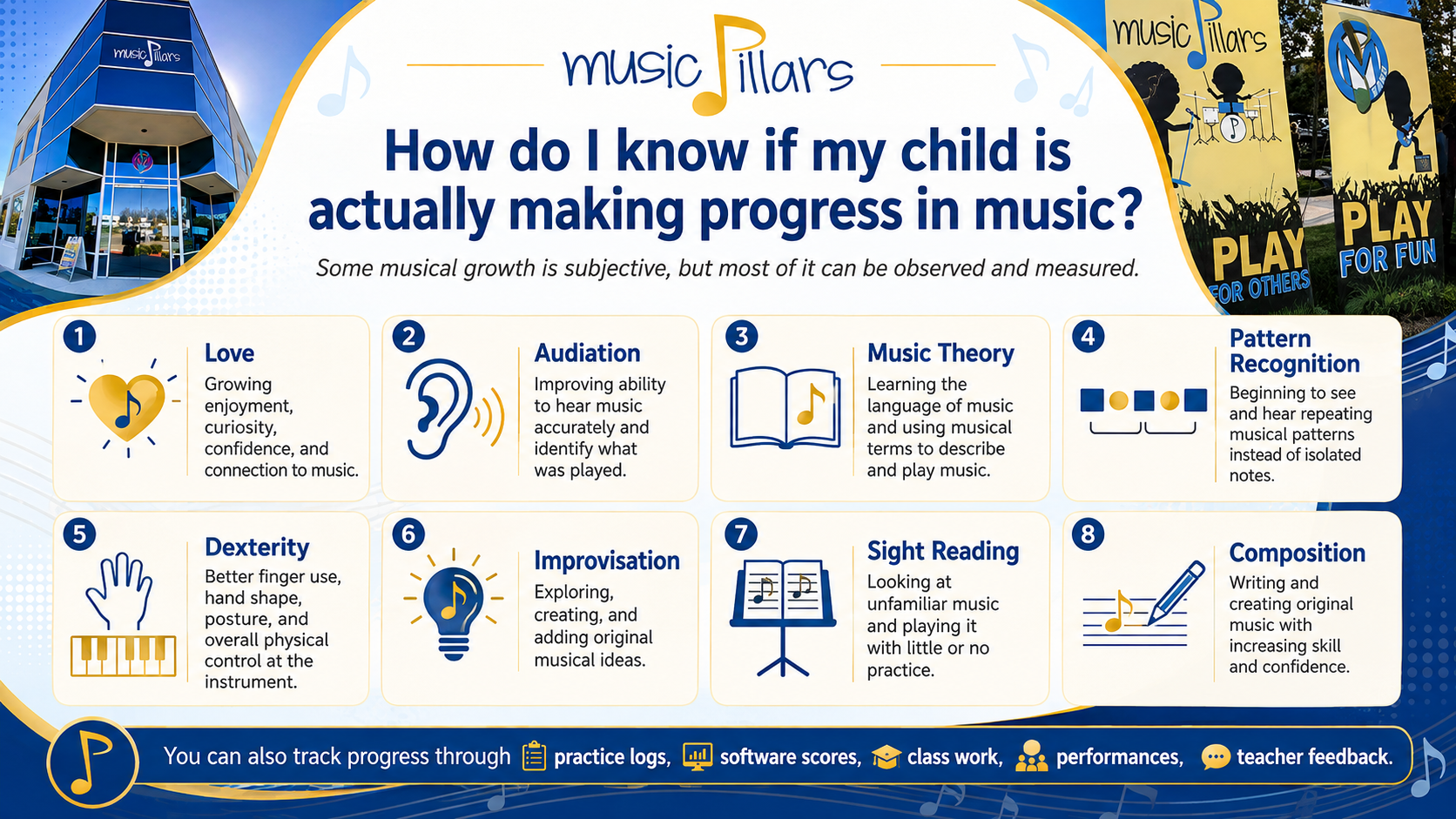
At Music Pillars, one way we think about musical development is through the different elements that make up our Music Pillars framework:
Love, Audiation, Music Theory, Pattern Recognition, Dexterity, Improvisation, Sight Reading, and Composition.
When you look at a child’s progress through each of these areas, it becomes much easier to see whether they are actually developing as a musician. In addition to that framework - it is also crucial that objective software feedback loops are used as a part of the child’s educational experience and learning. And/or the use of third-party accreditations such as the Royal Conservatory of Music, and their certification system.
Love
The first pillar is Love.
This is probably the most subjective area of musical growth. There is not necessarily a score we can assign to how much a child loves music.
But it is extremely important to us as a studio that we keep a love of music at the forefront of what we are doing.
A child who is becoming more curious about music, more confident, more interested in playing, or simply more connected to music is making progress.
Our goal is not just to teach children how to correctly play notes. We want them to develop a relationship with music that can continue throughout their lives.
Audiation
The next area is Audiation.
Audiation is a technical musical term, but to a layperson it essentially means the ability to hear something accurately and understand or describe it in musical terms.
At a very sophisticated level, a trained musician might hear a complicated chord and immediately understand exactly what they are hearing.
But for beginning students, audiation is much simpler and completely age- and level-appropriate.
One way we work on this every week at Music Pillars is through a game we call “Hear It.”
Students see six different musical examples printed in front of them. One student secretly chooses one of those examples and plays it. The other students then have to listen carefully and determine which of the six musical examples they heard.
As students progress, the music they are asked to hear and recognize becomes increasingly sophisticated.
So one very real way to measure progress is this: Can your child hear music more accurately today than they could several months ago?
Music Theory
The next pillar is Music Theory.
Music, just like any discipline, has an entire set of terms and words that are specific to music and mean very specific musical things.
One way you will know your child is progressing is that they will begin to understand and use musical terminology at increasing levels of sophistication.
As students progress, they should increasingly be able to describe what is happening in music using the correct musical vocabulary.
The next step is being able to actually apply music theory to the music they are playing.
As students move into higher levels, for example, they begin using lead sheets, understanding chords, and applying their knowledge of music theory while improvising and playing.
So in simple terms, progress in music theory means that a student can increasingly understand musical terms, describe music using those terms, and then apply that understanding when actually playing music.
Pattern Recognition
The next pillar is Pattern Recognition.
One of the signs that a student is becoming a more sophisticated musician is that they begin seeing and hearing the patterns within music.
A beginning student will often look at written music and see individual notes. More experienced musicians begin seeing how those notes are interconnected.
Music is full of patterns.
There are patterns in melodies, patterns in chords, and patterns in the overall structure of songs. Music also contains predictable and repeatable sections, often organized in groups such as 8, 16, or 32 measures.
As students progress, they begin seeing the larger musical picture instead of simply processing one individual note at a time.
That developing ability to recognize patterns is an important sign that your child is beginning to understand music at a deeper level.
Dexterity
The next pillar is Dexterity.
You will also see musical progress physically.
When children first begin playing piano, their fourth and fifth fingers—the ring finger and pinky—are almost always still developing physically. Beginning students will frequently resist using those fingers because they are simply more difficult to control.
As students progress, you will see them increasingly using all of their fingers comfortably.
You will also see improvements in their hand shape, wrist position, posture, and where and how they sit at the piano.
These may seem like small things, but they are very important.
Developing physical control of the hands and fingers allows students to eventually play music that would simply not have been physically possible for them when they first started.
Improvisation
Another important area is Improvisation.
You will know your child is progressing musically when they begin to develop—or build upon—their natural interest in creating music.
This might be a child hearing something on YouTube, Spotify, in a movie, or in the car and then sitting down at the piano and trying to figure out the melody.
It may also mean beginning to create short musical ideas or motifs of their own.
Eventually students may begin adding their own ideas to an existing musical structure, changing melodies, creating accompaniments, or experimenting with music simply because they are curious about what something might sound like.
That movement from simply reproducing music toward exploring and creating music is another important sign of musical growth.
Sight Reading
Sight reading is the acquired skill of looking at music you have never played before and then being able to play it with little or no practice.
This is something we work on during every class at Music Pillars.
Typically, the first five to seven minutes of each session include sight-reading work.
The way you will know your child is progressing in sight reading is straightforward: they will increasingly be able to look at music of greater complexity and play it accurately with little or no preparation.
Sight reading is an incredibly valuable musical skill because musicians ultimately need to develop two complementary abilities.
One is the ability to hear music and figure out how to play it without written music.
The other is the ability to look at written music, understand it, and play it.
Both skills are extremely valuable and represent important parts of becoming a well-rounded musician.
Composition
The final pillar is Composition.
Every week in class, our students compose short pieces of music.
Sometimes we use composition to cement an understanding of a particular music-theory concept. Other times students compose simply to make a personal musical statement or express an idea through music.
Because composition happens regularly, we can actually watch that skill develop.
Over time, students become increasingly capable of taking the musical vocabulary they have learned and using it to create something of their own.
Their compositions become more sophisticated, more intentional, and more musically complete.
That is another very visible way to see musical progress.
Objective Measures of Progress
In addition to all of these areas, there are also some very objective ways of measuring your child’s progress.
Parents can look at their child’s practice logs, software activity, scores, and progress through their assigned music. We also wrote a lengthier post about practice that you can read about here.
At Music Pillars, we deliberately combine traditional, off-computer, analog musical learning with a high degree of technology and software.
We believe both are valuable.
A teacher watching and listening to a child provides one type of information. A child composing, improvising, performing, and interacting with other musicians provides another.
And software can provide objective information about practice, accuracy, consistency, and progress over time.
When you put all of these things together, musical progress becomes much easier to see.
So while not every part of learning music can—or should—be reduced to a number, most musical development can be observed, measured, and tracked over time.
And ultimately, that is what we want: a child who not only plays increasingly difficult music, but who hears more, understands more, recognizes more, controls their instrument better, reads more fluently, creates more freely—and continues to love music along the way.