

What is the parent's role in making music lessons successful?
Music is a little different from many other activities in a child's life.
If your child plays soccer or basketball, the parent's role is often pretty straightforward: get them to practice, pick them up, and attend their games.
Music can be different because some of the learning and progress can also happen at home.
The most important thing isn't that every child practices a certain amount. The most important thing is that the expectations of the parent, student, and Music Pillars are aligned.
We think of students as being on one of three paths:
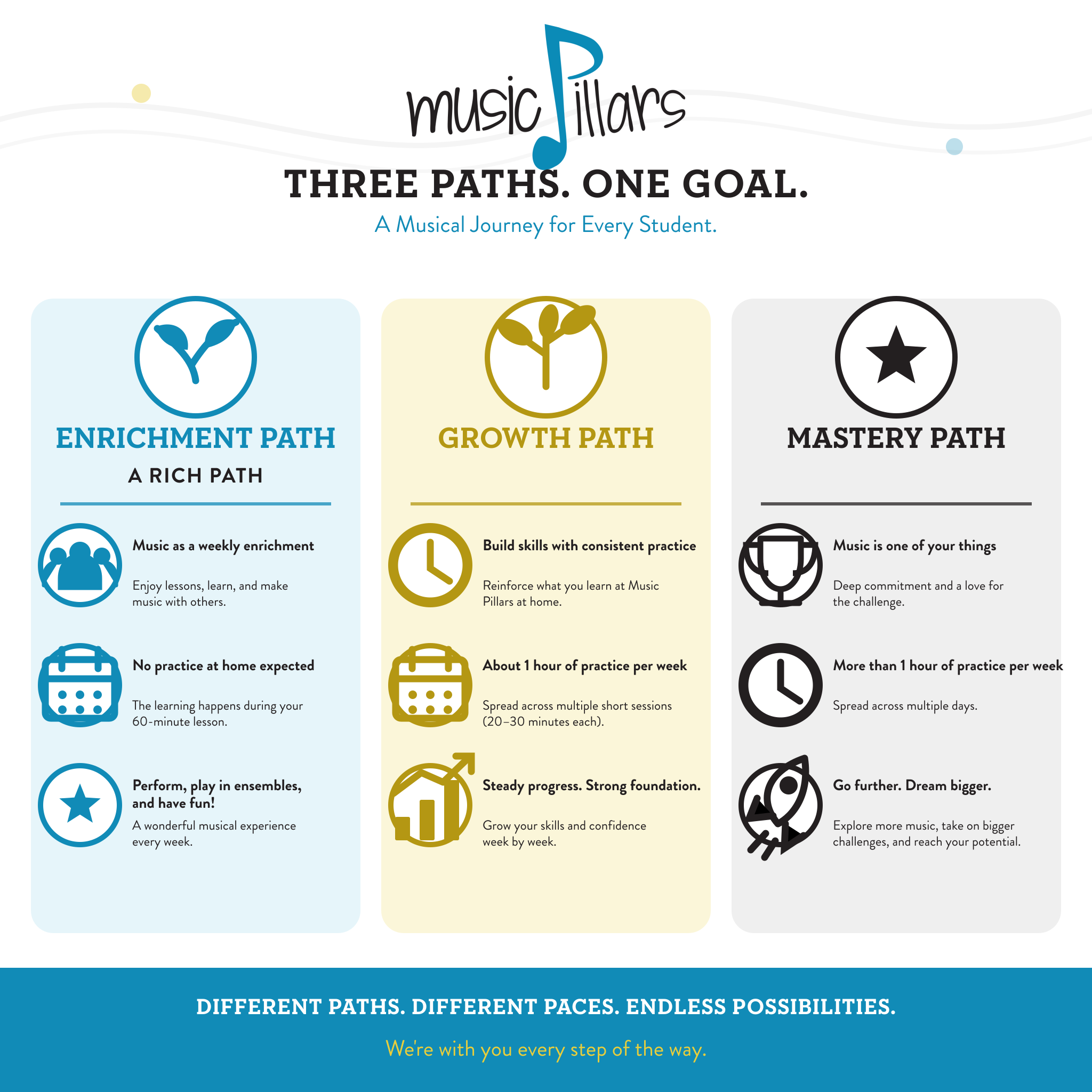
Enrichment Path
Music is primarily a once-a-week enrichment experience.
The student comes to their 60-minute lesson, participates, works hard while they are here, learns music, plays with other students, and enjoys the experience.
There is no expectation of practice at home on the Enrichment Path.
Students will naturally progress at a different pace than students who practice regularly at home, and that's perfectly fine. They will still learn, participate in performances, play ensemble music, have opportunities to perform solos, and receive the many benefits that come from having music in their lives.
We are happy to have students on the Enrichment Path.
Growth Path
Students on the Growth Path are taking what they learn at Music Pillars and reinforcing it at home.
Our general expectation is approximately one hour of practice per week between lessons, spread across multiple practice sessions.
For example, that might mean three 20-minute sessions or two 30-minute sessions.
We generally don't recommend doing the entire hour in one sitting. Shorter, repeated practice sessions tend to be much more productive.
Students log into the software they already use at Music Pillars, work through their music, and receive feedback as they practice.
Mastery Path
The Mastery Path doesn't mean that the student has already "mastered" music. It describes the student's level of interest and commitment.
For these students, music is becoming one of their things.
They typically practice more than an hour each week, spread across multiple days. They may also explore songs or music outside of the regular curriculum simply because they enjoy it, want the challenge, or are excited about becoming better musicians.
Students on this path also need enough room in their schedules to pursue that interest. A child can't realistically make music a significant pursuit if every afternoon and evening is already filled with other activities.
None of these three paths is "better" than another.
They represent different levels of commitment—not different levels of worth or success.
A student having a wonderful musical experience for 60 minutes every week can absolutely be successful. Our goal is simply to make sure the student, parent, and studio understand and agree upon the path we're pursuing together.
What does practice at home look like on each path?
Enrichment Path: No practice at home is expected. Come to Music Pillars each week, participate, learn, and enjoy making music.
Growth Path: Approximately one hour per week of practice at home, preferably divided among several shorter sessions. Students use the same online tools and practice process they use at Music Pillars.
Mastery Path: More than one hour per week, spread across multiple days. These students will often go beyond assigned curriculum and explore additional music because they genuinely want to.
Can my child change paths?
Absolutely.
These paths aren't permanent. Children's interests, schedules, and priorities change.
A student might have plenty of time and enthusiasm for practicing during the summer and then have significantly less time once school, sports, and other activities begin. Likewise, a student who initially participates primarily for enrichment may suddenly become excited about music and want to spend considerably more time practicing.
If you notice a change—or if we notice one through the student's practice patterns—we can simply have a conversation.
The goal isn't to keep a student locked into a particular path. The goal is to keep the student, family, and studio aligned.
What if my child doesn't practice but still wants to take lessons?
We would love to have them.
That's exactly what the Enrichment Path is for.
We will continue doing our best to make your child's experience positive, engaging, interesting, and fun. We aren't going to make music unpleasant simply because a student isn't practicing outside of lessons.
Students can learn a great deal by spending a quality 60 minutes making music every week, and we believe that musical enrichment has real value.
Will my child still perform if they're on the Enrichment Path?
Yes. Absolutely.
During Music Pillars lessons, students learn two to three pieces they can perform as part of an ensemble.
During the individual/lab portion of their 60-minute lesson, students also work individually through music using our learning software. As they complete and pass songs, those pieces can become opportunities for solo performances.
So students on the Enrichment Path can participate in performances both as members of an ensemble and as soloists.
How can parents support practice at home?
We intentionally teach students how to practice while they're at Music Pillars.
Students know how to log into the learning software, where to go, and how to use the same practice process at home that they use at the studio. The information they need to access the system is also listed on the back of their books.
Parents can log in and see what their child has been doing and how they're progressing.
And, of course, parents are always welcome to speak with their child's teacher or the lab instructor if they have questions or need additional support.
How much should I remind my child to practice?
We want to build positive motivation around music rather than turn practice into a constant battle at home.
At Music Pillars, we use visual incentives, small rewards, encouragement, and public recognition to celebrate students who practice at home and students who give their best effort during lessons.
For students on the Growth Path, however, we do need some help from parents.
One of the most helpful things a parent can do is create predictable practice times during the week. Both the child and parent should know when those times are.
That provides structure and accountability without requiring Mom or Dad to become the daily practice police.
What if my child wants to move through the levels faster?
Wonderful! We love seeing that motivation.
One of the benefits of learning alongside other students is some natural, positive peer motivation. Sometimes another student will complete a level first simply because they started earlier or have been practicing more between lessons.
If your child becomes motivated to progress faster, the biggest thing they can do is practice consistently at home.
Students can also talk with us about opportunities to come into the studio for additional time working in the lab and on their songs. We're happy to support students who are excited and motivated to accelerate their progress.
What's the big idea behind the three paths?
We don't believe every child needs to approach music with the same goals.
Some students want music to be a wonderful weekly enrichment activity.
Some want to practice consistently and steadily develop their skills.
And some discover that music is becoming a major interest and want to pursue it with considerably more time and energy.
All three are welcome at Music Pillars.
Success doesn't mean forcing every student onto the Mastery Path.
Success means having the student, parent, and studio aligned around realistic expectations, then creating a positive musical experience within those expectations.
And when those expectations change, we simply change the path.